
Botanical Identification Testing: Techniques, Methods & Importance.
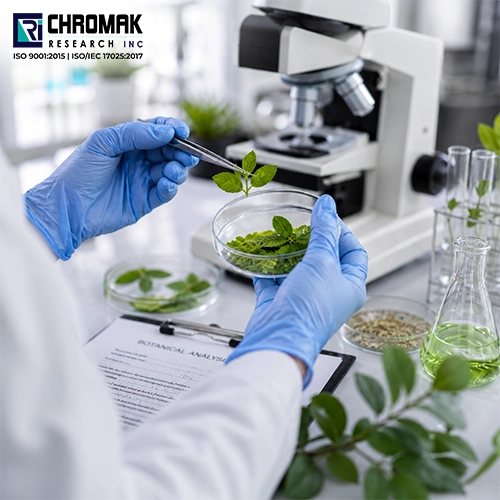
In today’s rapidly growing herbal and pharmaceutical market, ensuring the authenticity and quality of plant-based products is critical. Botanical identification testing plays a key role in verifying the correct plant species and preventing adulteration or contamination.
As the demand for herbal medicines and nutraceuticals grows, labs are now using sophisticated methods such as HPLC and HPTLC to conduct accurate analytical testing of plant extracts. In this blog, we will talk about the botanical testing work, the advantages of chromatographic methods, and their usefulness in quality control.
What is Botanical Identification Testing?
Botanical identification testing is the process of ascertaining the identity and purity of plant-based material through the use of scientific methods. It ensures the availability of the correct species of plants and active compounds in a sample.
The most commonly used techniques are:
High-performance liquid chromatography (HPLC).
HPTLC (High-Performance Thin Layer chromatography)
They are applied to perform a phytochemical analysis and to obtain a unique chemical profile (or fingerprint) of the plant extract.
Important Methods for Botanical ID Testing
1. HPLC Profiling of Plant Extracts.
HPLC is a highly precise analytical technique that is applied to isolate, identify and quantify compounds in a sample. Individual bioactive compounds are identified in the HPLC profiling of plant extracts using their retention time and concentration.
This technique is common in:
Quality control of herb products.
Determination of active ingredients.
Quantitative analysis of plant compounds
2. HPTLC Fingerprint Analysis (Extract Fingerprinting)
HPTLC is usually applied in the analysis of fingerprints or extract fingerprinting. It gives a visual representation of the chemical composition of a plant extract.
The individual plant species generate a distinct chromatographic pattern, which assists in:
Identifying plant authenticity
Detecting adulteration
Comparing batch consistency
This renders HPTLC as a crucial instrument in the botanical ID analysis.
Difference Between HPLC and HPTLC in Botanical Testing
These two methods are significant, but have slightly different applications in botanical identification tests:
| Feature | HPLC (High-Performance Liquid Chromatography) | HPTLC (High-Performance Thin Layer Chromatography) |
| Purpose | Quantitative analysis of compounds | Qualitative fingerprint analysis |
| Output | Chromatogram with numerical data | Visual bands/spots (fingerprint pattern) |
| Sensitivity | Very high | Moderate |
| Accuracy | Highly precise | Good for identification |
| Speed | Slower | Faster (multiple samples at once) |
| Sample Handling | One sample at a time | Multiple samples simultaneously |
| Application | Compound identification and measurement | Extract fingerprinting and comparison |
| Role in Botanical Testing | Confirms active compounds | Verifies identity and detects adulteration |
Both techniques are typically employed simultaneously in order to provide full and dependable botanical ID testing.
Why Botanical Identification Testing is Important
Botanical identification testing is crucial in ensuring safety and herbal product quality control.
Here’s why:
Ensures the correct plant species is used.
Avoids contamination and replacement.
Supports regulatory compliance
Ensures uniformity in herb preparations.
Strengthens herbal product quality control
Even the slightest changes in the product can change its efficacy and safety without reliable analytical testing of plant extracts.
Chromatography in Botanical testing.
Chromatography in botanical testing is the backbone of modern plant analysis. Methods such as HPLC and HPTLC enable the researchers to resolve complicated mixtures into recognizable elements.
This enables:
Accurate phytochemical analysis
Detection of impurities
Confirmation of active compounds.
Reliable quality assessment
A combination of these techniques would enable the laboratories to provide accurate and reproducible results.
How Can Chromak Research Help with Your Botanical ID Testing Needs?
In matters of good botanical identification testing, the appropriate lab must be selected. At Chromak Research, we specialize in providing quality, reliable, and correct analytical services to herbal and pharmaceutical companies.
This is why Chromak Research is special:
High-performance methods such as HPLC and HPTLC to test botanical ID.
Analytical testing of plant extracts.
Good phytochemical analysis and fingerprinting analysis.
Accurate reporting with detailed chromatographic data.
We ensure that our team tests all the samples correctly, and it helps clients to maintain the authenticity of the products and adherence to regulations.
Conclusion
As the demand for herbal and plant-based products continues to rise, the need for accurate botanical identification testing becomes even more critical. Techniques like HPLC and HPTLC provide reliable resolutions in aiding to verify the identity of the plant, quality, and safe product development. The current botanical ID tests are based on these techniques, beginning with phytochemical analysis and proceeding to extract fingerprinting. By investing in appropriate testing, manufacturers can maintain the integrity of their products and become confident in the market.
FAQs
Disclaimer: All the information on this blog is published in good faith and for general information purposes only. The information contained in this blog might be provided on an “as is” based on Wikipedia, Google, and other scientific articles. We are not liable for any injuries or damages for the use of the information. Please do your research before you use this information for any purpose.