UV-Visible Spectroscopy: Principles, Applications, and Benefits in Analytical Testing
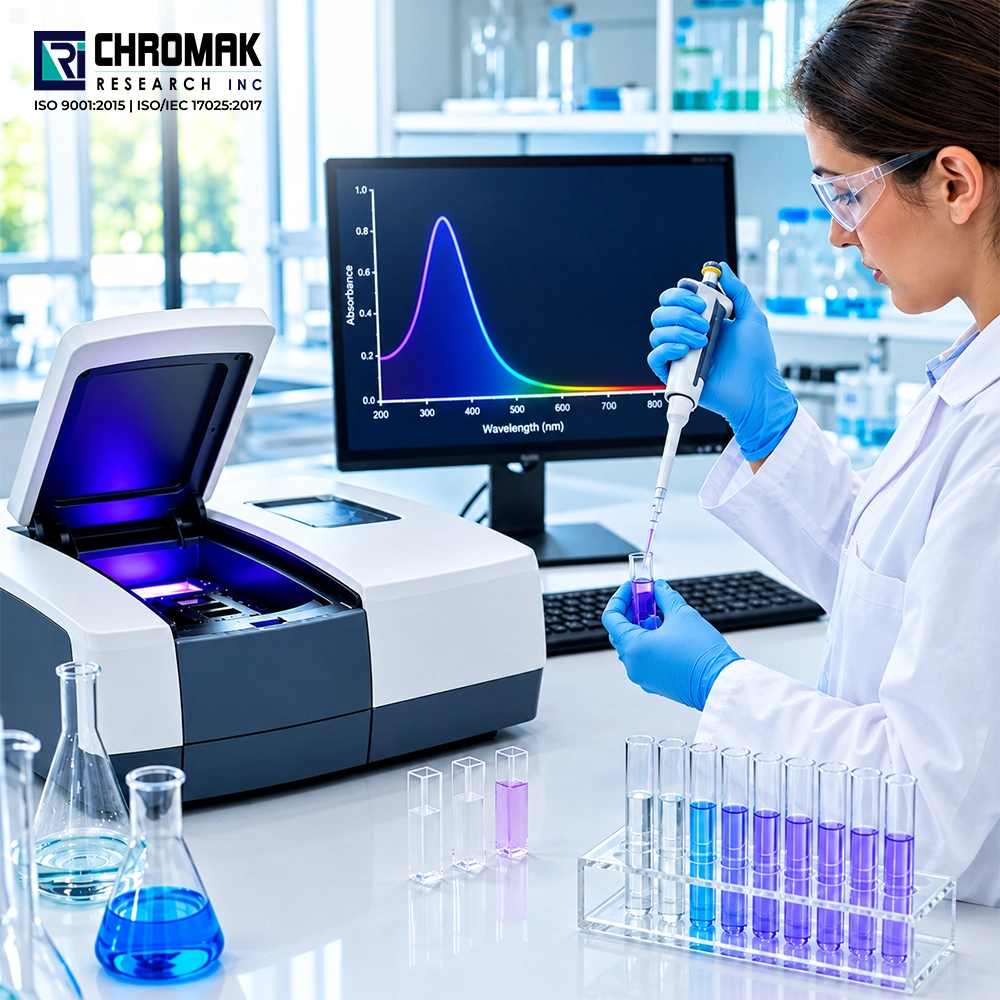
Analytical testing plays an important role in evaluating product quality, chemical composition, and concentration levels across different industries. UV-Visible Spectroscopy is a widely used analytical technique that helps laboratories measure the absorption of ultraviolet and visible light by substances. It supports quantitative analysis, raw material evaluation, pharmaceutical testing, and quality control.
From pharmaceutical formulations to food products and chemical compounds, this technique provides valuable information about sample composition and consistency. Understanding its working principle, applications, and benefits helps businesses select appropriate analytical testing approaches for their products.
What Is UV-Visible Spectroscopy?
UV-Visible Spectroscopy, also called UV-Vis spectroscopy, is an analytical technique that measures how much ultraviolet and visible light a sample absorbs or transmits at selected wavelengths. It is commonly used to determine the concentration of light-absorbing compounds in solutions.
The technique generally operates across ultraviolet and visible wavelength regions, approximately 190–800 nm, depending on the instrument and application. It is particularly useful for analyzing compounds that contain chromophores, which are molecular structures responsible for light absorption.
Laboratories use this method for concentration measurement, impurity evaluation, reaction monitoring, and analytical method development.
Working Principle: Beer-Lambert Law
The working principle is based on the Beer-Lambert law, which describes the relationship between light absorption and analyte concentration.
The equation is:
Where:
According to this relationship, absorbance is proportional to concentration when other conditions remain constant and the measurement is within the method's applicable range.
By measuring absorbance at a selected wavelength and comparing the result with a calibration curve or validated reference procedure, laboratories can determine the concentration of substances in a sample.
Key Components of a UV-Visible Spectrophotometer
A UV-Visible spectrophotometer consists of several components that work together to measure light absorption.
Together, these components enable laboratories to perform qualitative and quantitative measurements.
4. Major Applications Across Industries
UV-Vis analysis supports different analytical requirements across several industries.
These applications make the technique valuable for laboratories requiring routine analytical measurements and product evaluation.
Benefits of UV-Visible Spectroscopy
This analytical method offers several practical advantages:
The suitability of each application depends on sample composition, method sensitivity, and validation requirements.
Factors Affecting UV-Vis Testing Accuracy
Reliable analytical results depend on appropriate sample preparation and measurement conditions. Several factors can influence measurement accuracy:
Following established analytical procedures helps improve consistency and reproducibility.
Why Choose Chromak Research for UV-Visible Spectroscopy Testing?
Chromak Research provides UV-Visible Spectroscopy testing services for pharmaceutical, chemical, cosmetic, food, agricultural, microbiology, and life science applications. Its analytical capabilities include tailored method development and qualification to address specific product and process requirements. Chromak Research follows USP <857>-aligned procedures for its testing services and emphasizes reliable analytical results, affordable testing solutions, and prompt reporting. Whether businesses require concentration analysis, API assay, dissolution studies, or product evaluation, Chromak Research supports their analytical testing and research requirements through dedicated laboratory services.
Conclusion
UV-Visible Spectroscopy is a valuable analytical technique for concentration measurement, product evaluation, and laboratory quality control. Its versatility across industries makes it useful for routine testing and specialized analytical applications. Selecting appropriate methods, preparing samples correctly, and maintaining suitable measurement conditions help laboratories obtain reliable results. Partnering with an experienced analytical testing laboratory such as Chromak Research can further support product evaluation, research, and quality assurance requirements.
Frequently Asked Questions
It is used to measure light absorption and determine the concentration of suitable compounds in samples. Applications include pharmaceutical analysis, chemical testing, and quality control.
It describes the relationship between absorbance, molar absorptivity, optical path length, and analyte concentration.
Pharmaceuticals, chemicals, cosmetics, food, agriculture, biotechnology, and life sciences use this technique for various analytical applications.
Yes. It supports API assay, dissolution studies, and other suitable pharmaceutical analytical applications.
Sample preparation, wavelength selection, cuvette compatibility, instrument performance, and blank preparation can influence results.
Yes. Chromak Research offers tailored analytical method development and qualification based on specific product and testing requirements.
Disclaimer: All the information on this news is published in good faith and for general information purposes only. The information contained in this news might be provided on an “as is” based on Wikipedia, Google, and other scientific articles. We are not liable for any injuries or damages for the use of the information. Please do your own research before you use this information for any purpose.